

Articolo del 28/10/2026
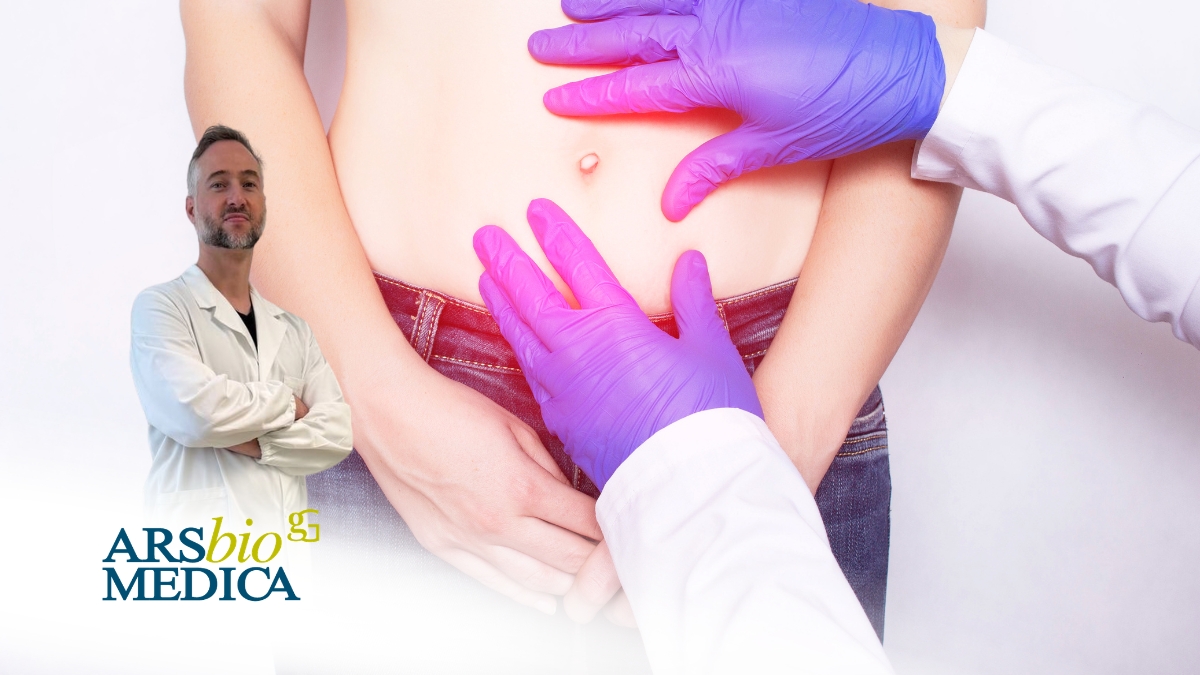
That bothersome bulge in your abdominal wall that you’ve been ignoring? It could be a hernia.
Have you noticed a small lump in your abdomen or groin that becomes more pronounced when you cough, strain, or stand for long periods?
First, let’s understand what a hernia actually is.
We discussed the topic with Dr. Luca Gordini, a general surgeon specializing in abdominal wall reconstruction at the Arsbiomedica Clinic. Dr. Gordini is a member of the European Hernia Society—a global benchmark association for hernia treatment—where he serves on the Quality Committee.
A hernia occurs when an organ (or part of it) or tissue pushes through a weak spot in the surrounding muscle or connective tissue. This can happen through a natural opening—such as the inguinal canal in the case of indirect (or external oblique) inguinal hernias—or through a defect in the linea alba, as seen in epigastric hernias.
It is not a condition to be overlooked. Over time, hernias tend to enlarge progressively and cause symptoms such as pain, a sensation of heaviness, and general discomfort. In severe cases, serious complications can arise—such as hernia strangulation—which may require emergency surgery.
For this reason, a surgical consultation is essential. An evaluation with a specialist allows you to assess the hernia’s status and decide whether surgical intervention is necessary or if active surveillance under proper guidance remains a viable option.
Do All Abdominal Hernias Require Surgery?
First and foremost, it is crucial to clarify that hernias do not heal on their own. A hernia is a mechanical issue—an actual defect or opening in the abdominal wall—that triggers structural changes and impairs proper abdominal function. Consequently, conservative treatments are ineffective; surgery (via open, laparoscopic, or robotic approaches) remains the only definitive solution.
Hernias are categorized based on their anatomical location:
-
Inguinal Hernia: The most common type, appearing in the groin area above the inguinal ligament; it affects men more frequently.
-
Femoral (Crural) Hernia: Develops in the femoral canal below the inguinal ligament and is more common in women.
-
Umbilical Hernia: The second most common type, occurring in the navel region.
-
Epigastric Hernia: Occurs along the linea alba in the upper midline of the abdomen above the navel.
-
Incisional Hernia (Incisional Ventral Hernia / Laparocele): A hernia that develops at the site of a previous surgical scar.
While these are the most frequently encountered types, rarer forms also exist, such as Spigelian, obturator, flank, and lumbar hernias.
How Do Hernias Present?
Typically, a patient notices a swelling or bulge that becomes more prominent when intra-abdominal pressure increases—such as when standing, coughing, or lifting heavy objects. This is often accompanied by a feeling of heaviness or a dull discomfort, and sometimes pain that worsens with physical exertion.
Globally, more than 20 million repair procedures for inguinal and ventral hernias are performed every year.
Today, a wide range of surgical techniques and approaches are available. Repair is no longer limited to traditional “open” surgery (involving a conventional incision); modern care frequently utilizes minimally invasive laparoscopic or robotic techniques. These methods promote faster recovery times, minimize trauma to the abdominal wall, and yield superior cosmetic results.
Because of this variety, an abdominal wall surgeon must tailor the chosen technique and approach to the specific characteristics of both the patient and the defect.
However, because patients can often manage their day-to-day symptoms, there is a tendency to delay visiting a specialist. This delay increases the risk of needing emergency surgery—an eventuality that occurs in over 7% of cases when treatment can no longer be postponed.
What Is the Recovery Time After Surgery?
Recovery depends heavily on the specific procedure performed. As mentioned, abdominal wall surgery has advanced significantly over the past decade.
The vast majority of hernia repairs can now be performed using minimally invasive techniques, allowing for shorter recovery periods and an earlier return to daily activities. However, patients must follow post-operative instructions and refrain from heavy physical exertion for an adequate period. This ensures optimal tissue healing and proper integration of the surgical mesh (when used).
Generally, barring any specific contraindications, patients can begin walking immediately (which is, in fact, essential for early rehabilitation), resume driving after 3 to 4 days, and start light jogging after roughly 20 days.
The primary goal of the intervention is to restore the patient to an active lifestyle comparable to the one they enjoyed before the hernia developed.
From Daily Life to Decision-Making: When Is It Time for Surgery?
Only a specialized consultation with an experienced abdominal wall surgeon can accurately diagnose the defect and determine the timing and approach for treatment.
Dr. Gordini and the team at the Arsbiomedica Clinic provide comprehensive patient care at every step: from precision diagnostics using advanced imaging to modern minimally invasive surgery, followed by personalized pre-habilitation and post-operative rehabilitation. Our state-of-the-art operating rooms combine cutting-edge technology with compassionate, patient-centered care.